Feeding is the process by which organisms, typically animals, obtain food. Terminology often uses either the suffixes -vore, -vory, or -vorous from Latin vorare, meaning "to devour", or -phage, -phagy, or -phagous from Greek φαγεῖν (phagein), meaning "to eat".





Evolutionary history
The evolution of feeding is varied with some feeding strategies evolving several times in independent lineages. In terrestrial vertebrates, the earliest forms were large amphibious piscivores 400 million years ago. While amphibians continued to feed on fish and later insects, reptiles began exploring two new food types, other tetrapods (carnivory), and later, plants (herbivory). Carnivory was a natural transition from insectivory for medium and large tetrapods, requiring minimal adaptation (in contrast, a complex set of adaptations was necessary for feeding on highly fibrous plant materials).[1]
Evolutionary adaptations
The specialization of organisms towards specific food sources is one of the major causes of evolution of form and function, such as:
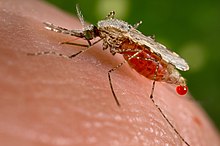
- mouth parts and teeth, such as in whales, vampire bats, leeches, mosquitos, predatory animals such as felines and fishes, etc.
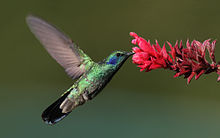
- distinct forms of beaks in birds, such as in hawks, woodpeckers, pelicans, hummingbirds, parrots, kingfishers, etc.
- specialized claws and other appendages, for apprehending or killing (including fingers in primates)
- changes in body colour for facilitating camouflage, disguise, setting up traps for preys, etc.
- changes in the digestive system, such as the system of stomachs of herbivores, commensalism and symbiosis
Classification
By mode of ingestion
There are many modes of feeding that animals exhibit, including:
- Filter feeding: obtaining nutrients from particles suspended in water
- Deposit feeding: obtaining nutrients from particles suspended in soil
- Fluid feeding: obtaining nutrients by consuming other organisms' fluids
- Bulk feeding: obtaining nutrients by eating all of an organism.
- Ram feeding and suction feeding: ingesting prey via the fluids around it.
By mode of digestion
- Extra-cellular digestion: excreting digesting enzymes and then reabsorbing the products
- Myzocytosis: one cell pierces another using a feeding tube, and sucks out cytoplasm
- Phagocytosis: engulfing food matter into living cells, where it is digested
By food type
Polyphagy is the ability of an animal to eat a variety of food, whereas monophagy is the intolerance of every food except of one specific type (see generalist and specialist species).
Another classification refers to the specific food animals specialize in eating, such as:
- Carnivore: the eating of animals
- Araneophagy: eating spiders
- Avivore: eating birds
- Corallivore: Eating Coral
- Durophagy: eating hard-shelled or exoskeleton bearing organisms
- Egg predation: eating eggs (but also see "Intrauterine cannibalism" below), also Ovivore
- Haematophagy: eating blood
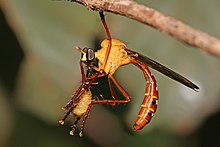
- Insectivore: eating insects
- Myrmecophagy: eating ants and/or termites
- Invertivore: eating invertebrates
- Keratophagy or Ceratophagy: eating horny material, such as wool by cloths moths, or snakes eating their own skin after ecdysis.
- Lepidophagy: eating fish scales
- Molluscivore: eating molluscs
- Mucophagy: eating mucus
- Ophiophagy: eating snakes
- Piscivore: eating fish
- Anurophagy: eating frogs
- Spongivore: eating sponges
- Teuthophagore: eating mainly squid and other cephalopods
- Vermivore: eating worms
- Zooplanktonivore: eating zooplankton
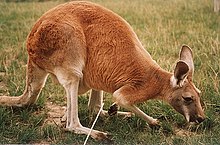
- Herbivore: the eating of plants
- Exudativore: eating plant and/or insect exudates (gum, sap, lerp, etc.)
- Gumivore: eating tree gum
- Folivore: eating leaves
- Florivore: eating flower tissue prior to seed coat formation
- Frugivore: eating fruits
- Graminivore: eating grasses
- Granivore: eating seeds
- Nectarivore: eating nectar
- Palynivore: eating pollen
- Phytoplanktonivore: eating phytoplankton
- Xylophagy: eating wood
- Exudativore: eating plant and/or insect exudates (gum, sap, lerp, etc.)
- Omnivore: the eating of both plants, animals, fungi, bacteria etc. The term means "all-eater".
- By amount of meat in diet
- Hypercarnivore: more than 70% meat
- Mesocarnivore: 30–70% meat
- Hypocarnivore: less than 30% meat
- Fungivore: the eating of fungus
- Bacterivore: the eating of bacteria
The eating of non-living or decaying matter:
- Coprophagy: eating faeces
- Detritivore: eating decomposing material
- Geophagy: eating inorganic earth
- Osteophagy: eating bones
- Saprophagy: eating decaying organic matter
- Scavenger: eating carrion
There are also several unusual feeding behaviours, either normal, opportunistic, or pathological, such as:
- Cannibalism: feeding on members of the same species
- Anthropophagy: the practice of eating human flesh
- Intrauterine cannibalism
- Oophagy or Ovophagy: the embryo/foetus eats sibling eggs
- Embryophagy: the foetus eats sibling embryos
- Filial cannibalism
- Self-cannibalism: feeding on parts of one's own body (see also autophagy)
- Sexual cannibalism: cannibalism after mating
- Kleptoparasitism: stealing food from another animal
- Kleptopharmacophagy: act of stealing chemical compounds for consumption
- Lignophagia: eating wood, typically a pathological condition in some domestic animals
- Paedophagy: eating young animals
- Pica: appetite for largely non-nutritive substances, e.g. clay or hair, sometimes in pregnancy or in pathological states, typically a medical or veterinary concern.
- Placentophagy: eating placenta
- Trophallaxis: eating food regurgitated by another animal
- Zoopharmacognosy: self-medication by eating plants, soils, and insects to treat and prevent disease.
An opportunistic feeder sustains itself from a number of different food sources, because the species is behaviourally sufficiently flexible.
Storage behaviours
Some animals exhibit hoarding and caching behaviours in which they store or hide food for later use.
Others
Alcohol – it is widely believed that some animals eat rotting fruit for this to ferment and make them drunk, however, this has been refuted in the case of at least elephants.
| This article uses material from the Wikipedia article Metasyntactic variable, which is released under the Creative Commons Attribution-ShareAlike 3.0 Unported License. |