For these animals, there is documented evidence of homosexual behavior of one or more of the following kinds: sex, courtship, affection, pair bonding, or parenting, as noted in researcher and author Bruce Bagemihl's 1999 book Biological Exuberance: Animal Homosexuality and Natural Diversity.


Bagemihl writes that the presence of same-sex sexual behavior was not "officially" observed on a large scale until the 1990s due to observer bias caused by social attitudes towards nonheterosexual people, making the homosexual theme taboo.[2][3] Bagemihl devotes three chapters, "Two Hundred Years at Looking at Homosexual Wildlife", "Explaining (Away) Animal Homosexuality" and "Not For Breeding Only" in his 1999 book Biological Exuberance to the "documentation of systematic prejudices" where he notes "the present ignorance of biology lies precisely in its single-minded attempt to find reproductive (or other) 'explanations' for homosexuality, transgender, and non-procreative and alternative heterosexualities."[4] Petter Bøckman, academic adviser for the Against Nature? exhibit, stated "[M]any researchers have described homosexuality as something altogether different from sex. They must realize that animals can have sex with who they will, when they will and without consideration to a researcher's ethical principles." Homosexual behavior is found amongst social birds and mammals, particularly the sea mammals and the primates.[3]
Sexual behavior takes many different forms, even within the same species and the motivations for and implications of their behaviors have yet to be fully understood. Bagemihl's research shows that homosexual behavior, not necessarily sex, has been documented in about five hundred species as of 1999, ranging from primates to gut worms.[2][5] Homosexuality in animals is seen as controversial by social conservatives because it asserts the naturalness of homosexuality in humans, while others counter that it has no implications and is nonsensical to equate natural animal behaviors to morality.[6][7] Sexual preference and motivation is always inferred from behavior. Thus homosexual behavior has been given a number of terms over the years. The correct usage of the term homosexual is that an animal exhibits homosexual behavior, however this article conforms to the usage by modern research,[8][9][10][11] applying the term homosexuality to all sexual behavior (copulation, genital stimulation, mating games and sexual display behavior) between animals of the same sex.
Mammals
- Selected mammals from the full list
- Baboon
- Bison[12]
- Bonobo[13]
- Brown bear[14]
- Brown rat[15]
- Cavy[15]
- Caribou[16]
- Cat (domestic)[17]
- Cattle (domestic)[18]
- Chimpanzee[19][20][21][22]
- Common dolphin[23]
- Common marmoset[24]
- Dog[25]
- Elephant[26]
- Fox[27]
- Giraffe[3][28][29]
- Goat[12]
- Horse (domestic)[30]
- Human[31][32][33]
- Koala[34]
- Lion[31]
- Orca[23]
- Panda
- Raccoon[35]
Birds
- Selected birds from the full list
- Barn owl[36]
- Chicken[37]
- Common gull[38]
- Emu[39]
- House sparrow[40]
- Kestrel[36]
- King penguin[41]
- Mallard[42]
- Ostrich[39]
- Raven[43]
- Rock dove[44]
Fish
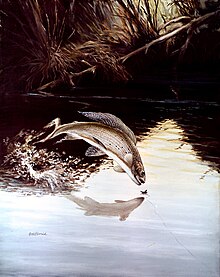
- Amazon molly[46]
- Anglerfish
- Blackstripe topminnow[47]
- Bluegill sunfish[47]
- Char[45]
- Grayling[45]
- European bitterling[48]
- Green swordtail[48]
- Guiana leaffish[49]
- Houting whitefish[45]
- Jewel cichlid[50]
- Least darter (Microperca punctulata)[48]
- Mouthbreeding fish sp.[47]
- Salmon spp.[51]
- Southern platyfish[48]
- Ten-spined stickleback[48]
- Three-spined stickleback[48]
Reptiles

The all-female Whiptail lizard species Aspidoscelis neomexicanus (center), which reproduces via parthenogenesis, is shown flanked by two sexual species having males, A. inornatus (left) and A. tigris (right). Research has shown that simulated mating behavior increases fertility for Aspidoscelis neomexicanus. One female lies on top of another, playing the role of the male, the lizard that was on bottom has larger eggs, in most cases. The lizards switch off this role each mating season.[52]
- Anole sp.[53]
- Bearded dragon[54]
- Blue-tailed day gecko (Phelsuma cepediana)[55]
- Broad-headed skink[48]
- Checkered whiptail lizard[54]
- Chihuahuan spotted whiptail lizard[54]
- Common ameiva[54]
- Common garter snake[48]
- Cuban green anole[53]
- Desert grassland whiptail lizard[54]
- Desert tortoise[56]
- Fence lizard[54]
- Five-lined skink[48]
- Gold dust day gecko (Phelsuma laticauda)[55]
- Gopher (pine) snake[47]
- Green anole[53]
- Inagua curlytail lizard[54]
- Jamaican giant anole[53]
- Laredo striped whiptail lizard[54]
- Largehead anole[53]
- Mourning gecko[57]
- Plateau striped whiptail lizard[54]
- Red diamond rattlesnake[48]
- Red-tailed skink[48]
- Seychelles giant tortoise[58]
- Side-blotched lizard[54]
- Speckled rattlesnake[48]
- Water moccasin[48]
- Western rattlesnake (Crotalus viridis)[48]
- Western banded gecko[57]
- Whiptail lizard spp.[54]
- Wood turtle[53]
- Blue-tongued skink
Amphibians
- Appalachian woodland salamander[59]
- Black-spotted frog[60]
- Mountain dusky salamander[59]
- Tengger desert toad[53]
Insects

Male homosexuality has been inferred in several species of dragonflies. A survey of damsel and dragonflies reveals characteristic cloacal pincher mating damage in 20–80 percent of the males, indicating a fairly high occurrence of sexual coupling between males.[61][62]

- Alfalfa weevil[64]
- Australian parasitic wasp sp.[64]
- Bean weevil sp.[64]
- Bedbug and other bug spp.[65][66]
- Blister beetle spp.[67]
- Blowfly[67]
- Broadwinged damselfly sp.[68]
- Cabbage (small) white (butterfly)[69]
- Checkerspot butterfly[69]
- Club-tailed dragonfly spp.[70]
- Cockroach spp.[71]
- Common skimmer dragonfly spp.[70]
- Creeping water bug sp.[72]
- Cutworm[73]
- Digger bee[74]
- Dragonfly spp.[70]
- Eastern giant ichneumon wasp[64]
- Eucalyptus longhorned borer[72]
- Field cricket sp.[75]
- Flour beetle[63]
- Fruit fly spp.[76]
- Glasswing butterfly[69]
- Hypoponera opacior ant[77]
- Grape berry moth[78]
- Grape borer[72]
- Green lacewing[79]
- Hen flea[79]
- House fly[80]
- Ichneumon wasp sp.[64]
- Japanese scarab beetle[81]
- Larch bud moth[78]
- Large milkweed bug[66]
- Large white[66]
- Long-legged fly spp.[82]
- Mazarine blue[66]
- Mexican white (butterfly)[66]
- Midge sp.[82]
- Migratory locust[83]
- Monarch butterfly[69]
- Narrow-winged damselfly spp.[68]
- Parsnip leaf miner[82]
- Pomace fly[82]
- Queen butterfly[69]
- Red ant sp.[82]
- Red flour beetle[66]
- Reindeer warble fly (Hypoderma tarandi)[82]
- Rose chafer (Macrodactylus subspinosus)[82]
- Rove beetle spp.[66]
- Scarab beetle (melolonthine)[84]
- Screwworm fly[82]
- Silkworm moth[78]
- Southeastern blueberry bee[74]
- Southern green stink bug[66]
- Southern masked chafer[82]
- Southern one-year canegrub[82]
- Spreadwinged damselfly spp.[68]
- Spruce budworm moth[78]
- Stable fly sp.[82]
- Stag beetle spp.[66]
- Tsetse fly[82]
- Water boatman bug[66]
- Water strider spp.[66]
Other invertebrates
- Blood-fluke[85]
- Box crab[86]
- Harvestman sp.[87]
- Hawaiian orb-weaver (spider)[87]
- Incirrate octopus spp.[86]
- Jumping spiders[87]
- Mite sp.[82]
- Spiny-headed worm[88]
| This article uses material from the Wikipedia article Metasyntactic variable, which is released under the Creative Commons Attribution-ShareAlike 3.0 Unported License. |